Tag Archives: Armenian

The World Is Wide


As the Armenian proverb puts it, The world is wide, but what use is it if my heart is narrow? How can we resist the urge to turn our faces away from the grim and ongoing spectacle of wholesale and retail slaughter in Gaza and Lebanon, massacres and land theft which are being perpetrated with our tax dollars and with the full-throated support of our government? The raging dumpster fires on every corner both domestically and internationally are designed to make us shrug and turn our backs. Most days when the big picture is overwhelming, I try to do even one small thing to make the world a little less cruel. And in coming together with other people—whether that be with my teammates at the Gaza Scholarship Initiative (GSI) or with my neighbors in our Morningside Rapid Response group—we find and create hope. There is hope in the work we do together, there is hope in Zohran Mamdani, the dynamic young mayor of New York City, and there is hope in supporting one person at a time as part of a broader movement for systemic change.

James and I are helping to raise funds for a talented young artist and writer in Gaza. She has been accepted with a fee waiver to a master’s program at the National College of Art and Design (NCAD) in Dublin, but in order to qualify for a student visa she needs money for her evacuation, resettlement, and living expenses. You can read more about her and donate here.

One of my GSI mentees, Asem Aljerjawi, has written an eloquent and moving piece about his life in Dublin after surviving genocide in Gaza and while his family is still suffering there.

Anti- and non-Zionist Jewish Columbia faculty, including James and a number of our friends who are quoted in this Guardian piece, have filed claims with Trump’s “antisemitism fund.”

On his podcast Why Is This Happening? Chris Hayes spoke with Timnit Gebru about the ethics of AI. I found the discussion illuminating. “Timnit Gebru founded the Distributed AI Research Institute after her high-profile exit from Google’s Ethical AI team.” After you listen to the episode, check out the AI Resist List.

M. Gessen wrote a sobering analysis of the batshit crazy ALIENS webpage the White House launched about ten days ago. When I saw it I assumed it had sprung directly from the brain of Stephen Miller.

Now repeat after me:

The only recognizable feature of hope is action. (Grace Paley)

Choose your lane, find your people. (Mariame Kaba)

Freedom is a constant struggle. (Angela Davis)

The voice of the people is louder than the roar of the cannon. (Armenian proverb)

Let’s go!

xo

Nancy


Proverbs for a Friend’s Baby on Her Baptism

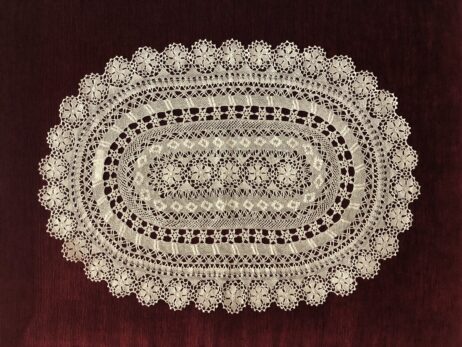
Armenian needlelace doily

This past Sunday, I was among those offering blessings at the baptism of a friend’s baby. In preparation, I paged through several anthologies and lists of Armenian proverbs that I have collected over the years and made and arranged the selection below.


Let’s sit crooked and talk straight.

The sun will rise whether the rooster crows or not.

Spring comes on the wings of the nightingale.

Birds fly with their wings, people with their kin.

Measure ten times, cut once.

Say it once, listen a thousand times.

Education is a golden bracelet.

You are as many people as the languages you know.

It is better to carry stones with a wise man than to eat pilaf with a fool.

A good tree is better than a bad person.

A lone walnut cannot make noise in a sack.

From heart to heart there is a path.

Tell me who your friend is and I will tell you who you are.

Be neither sweet and swallowed, nor sour and spurned.

Let it be one and fine.

A mother’s blessing will lift the curse of seven priests.


Nancy Kricorian


Doing and Undoing


Little by little the cotton is spun. ~ Armenian proverb

Every year on the 24th of April, Armenians around the world commemorate the start of the Armenian Genocide in 1915. For me this date is firmly anchored in my memories of my Armenian grandmother and the congregation of the United Armenian Brethren Church that my grandfather helped to found. My survivor grandmother and the other survivors of her generation in our church, many of them having been orphaned as children, were carriers of a traumatic history that was rarely articulated, but which suffused our community. Their experiences of unspeakable mass violence, dispossession, and exile were passed to the next generations as both a burden and a legacy.

I have always felt that my commitment to fairness as a child and to justice and accountability as an adult are the fruits of having grown up in the Armenian community. In this violent and frightening time, each day I try to find one kind thing I can do or one cruel thing I can help undo. Sometimes I do this alone, but most times I am part of a group. And these small acts and the relationships we make as we do them are the best antidotes to despair.


Recommended viewing, reading, listening

In honor of Armenian Genocide Remembrance Day here is a short video about the history of the Armenian village of Anjar in Lebanon’s Bekaa Valley. It features my friend Antranik Dakessian.

As reported by LitHub, a collective of autonomous writers, artists, and musicians has launched the 92NO campaign to call on their colleagues to withhold their labor from the Arts and Culture Program of 92NY because of the institution’s support for war and genocide. You can follow 92NO on Instagram and X/Twitter.

My WANN mentee Taqwa Ahmed Alwawi wrote a searing piece for LitHub about scholasticide in Gaza.

This is must-read interview with Dr. Ghassan Abu Sittah about health sovereignty in Palestine.

This fascinating episode of the Psychic Militancy podcast features a discussion with Avgi Saktepoulou and Iris Hefets about the Palestine Global Mental Health Network’s call for all psychoanalysts of conscience to resign from the International Psychoanalytic Association.

Palantir posted a 22-point “Western” tech supremacist manifesto on X/Twitter the other day that was described as sounding like “the ramblings of a supervillain.”  Eliot Higgins of Belling the Cat had a good BlueSky thread in response, and Yanis Varoufakis offered a point by point translation. If you’re interested in taking action against this company that poses a threat to humanity, sign up for the Purge Palantir campaign. More information is available from the American Friends Service Committee.

I was impressed by Wikipedia’s guide to spotting AI generated writing, and if you want a short primer, you can watch this reel by Will Francis.


Nancy Kricorian


The First of April


When the first crocuses appeared this year, I thought to myself, “We made it!” as though winter were a battle that we had survived. Now it’s April. The daffodils are blooming in Morningside Park, and the ornamental cherries are flaring their pink skirts along Central Park’s reservoir. I have never been a fan of practical jokes, hoaxes, or pranks, so April Fool’s Day is not a custom that I observe. April 1st was, however, my Armenian grandmother’s chosen birthday. As an orphaned genocide survivor whose birthdate was inscribed in a lost family Bible, she knew neither the day nor the year of her birth. April brings spring showers, spring flowers, and in Armenian the word abril (ապրիլ) is both this month and the verb to live.

How do we live in this dystopian moment when mere minutes of reading the headlines is like sprinting through a raging fire? While walking down the avenue, I am struck by how normal and peaceful everything appears even as I am carrying with me the knowledge of the mass murder of schoolgirls in Iran, the targeting of journalists, medics, and other civilians in Lebanon, and the ongoing genocide against the people of Palestine. And then there are the domestic horrors. So, after I register all of this, I must find something doable and I must do it. I know you have heard this from me before, but I literally repeat these phrases in my head each day, sometimes more than once: The only recognizable feature of hope is action (Grace Paley); Choose your lane, find your people (Mariame Kaba); Freedom is a constant struggle (Angela Davis).

My WANN mentee Nadera wrote a beautiful, sad piece about celebrating Ramadan before and after the genocide. I’ve been going to weekly meetings of our neighborhood deportation defense rapid response (DDRR) group. I have also been working with the DSA-NYC Immigrant Justice Working Group and its efforts with the Purge Palantir coalition. I did some preliminary campaign research on Palantir—truly the stuff of nightmares. (If you want to see my draft research document, let me know and I’ll send it to you, but in the meantime, check out Palantir CEO Alex Karp’s latest shenanigans.) There was some good news this week as the New York City Health and Hospitals Corporation announced they would not be renewing their contact with Palantir when it comes to an end in October. On another front, I’m collaborating with an autonomous group of fierce and clever writers on a campaign to hold a major cultural institution to account. We are finding moments of satisfaction, and, dare I say, joy in our work together.

Gathering in the real world with friends and family is another way of fostering light in dark times. James and I recently hosted a launch party for our friend Tim Mitchell’s brilliant new book The Alibi of Capital. In February, we restarted our old tradition of a monthly Sunday brunch. At our second gathering in March, as I looked around the table at our friends, I remembered lines from The Elder Edda (as translated from the Icelandic by Paul B. Taylor and W.H. Auden):

If you know a friend you can truly trust,

And wish for his good will,

Exchange thoughts, exchange gifts,

Go often to his house.

Finding these moments of connection make the work possible.

Yours in struggle,

Nancy

READ, LISTEN, LOOK

On March 13, The Burning Heart of the World was knocked out in the first round the Tournament of Books, but the judge’s reasoning and the conversation below were interesting. On March 27, I lost in the Zombie round, but there was some laudatory commentary.

In the good news department, a federal court has found that Columbia University may have acted as a government instrument to suppress Palestinian advocacy in violation of the First Amendment. This finding means the suit will go to discovery and all those emails between the craven trustees and their sketchy congressional partners will become public.

Via Mondoweiss Psychoanalysts are Resigning from the International Psychoanalytical Association over Its Anti-Palestinian Double Standard. Dr. Avgi Saketopoulou, a New York analyst and theorist, named something rarely spoken publicly: that the IPA’s silence has ‘created a permissive professional atmosphere in which Zionist analysts feel entitled to eruptions — saying racist and discriminatory things to their patients and supervisees — both in the consulting room and on our email lists.’

Arundhati Roy on the war against Iran: Any regimes that need changing, including the US, Israel, and ours, need to be changed by the people, not by some bloated, lying, cheating, greedy, resource-grabbing, bomb-dropping imperial power and its allies who are trying to bully the whole world into submission.

We Live in a Time of Monsters—a message from Beirut by Lina Mounzer: But we have learned from Gaza that there is no rule of law, and there are no repercussions for the crimes of the powerful.

Listen to the brilliant Aslı Ü. Bâli via Jewish Currents’ On the Nose Podcast.

Via Instagram. Enjoy these Heated Rivalry themed posters from 28 March No Kings Day. And take the Heated Rivalry Quiz (should I be proud or embarrassed to say that I knew all the answers?).


Nancy Kricorian


A Few Good Books


As 2025 draws to a close, I wanted to recommend a few of the best books I have recently read.

Sad Tiger by Neige Sinno, translated from the French by Natasha Lehrer. Neige Sinno tells the story of being sexually abused by her stepfather from the age of seven to thirteen, and examines literary, psychological, and cultural portrayals of and reactions to child sexual abuse and incest. I read this memoir in two days and was completely bowled over by its fierce intelligence. Words Without Borders published a fascinating interview with Sinno and her English translator.

Mother Mary Comes to Me by Arundhati Roy. A profound and moving memoir by internationally acclaimed writer Arundhati Roy, whose mother was a feminist icon in India as well as a difficult and at times abusive parent. It is a double portrait of mother and daughter that is honest and infused with unexpected grace. Listen to Mehdi Hasan’s great podcast interview with Arundhati.

North and South by Elizabeth Gaskell. First published in 1855, Gaskell’s novel about the differences between the rural south and the industrial north of England was described by one recent reader as “Pride and Prejudice for Socialists.” The conflict and inevitable romance between proud and idealistic Margaret Hale and hard-nosed industrialist John Thornton made the pages fly by. I also loved the 2004 BBC adaptation (despite the corny ending—the novel’s final lines were so much better).

Counterpunch’s Joshua Frank included my novel in his own Favorites of 2025 list! I’m still thrilled about its having been selected for the Tournament of Books shortlist—and the mention here on BookRiot. And if you’re on Goodreads and have read The Burning Heart of the World, please do leave a review or a rating. It helps increase awareness of the book. The same applies to LibraryThing and The StoryGraph.

As the genocide in Gaza grinds on through a blockade that leaves people in flooded and collapsing tents during winter storms, while hunger and lack of medicine continue to weaken and kill the most vulnerable, and Israel’s campaign of retail (rather than wholesale) murder rolls on, my friend and mentee Nadera has sent me a fundraising appeal for her family. “This money will help my family with living expenses: school and university fees for myself and my five siblings, rent for our apartment, clothes for all of us, water, electricity, food, and so on. As you know, the war stole everything from us, even my dad’s work. Thank you for your understanding!” If you would like to donate, please message me and I will give you the PayPal information for her cousin, who is collecting funds on Nadera’s behalf.

In early December, I spoke with Tamar Shirinian and Milena Abrahamyan on their Other Armenias podcast. We talked about my novels, writing, and solidarity. And Rebecca Evans wrote about our interview on the December episode of the Writer-To-Writer show on Radio Boise. It was actually a delight to speak with Rebecca and her co-host Ken Rodgers.

I’m not one for New Year’s resolutions, but as Grace Paley put it, “The only recognizable feature of hope is action.” To wit, I have recently rejoined the Immigrant Justice Working Group of DSA NYC. May we create more light and more justice in 2026.

Sirov,

Nancy


Nancy Kricorian, December 2025


Comfort and Light

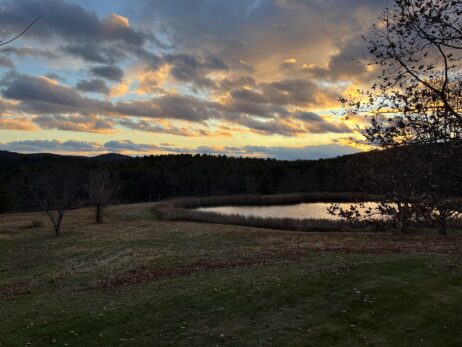
Sunset over a meadow with a pond


Some people go to priests; others to poetry; I to my friends, I to my own heart, I to seek among phrases and fragments something unbroken…

 ~ Virginia Woolf, The Waves

For the past two years, when people ask me how I am doing, I have found myself saying, “Genocide, climate catastrophe, and fascist takeover aside, on a personal level, I am okay.” But a quick perusal of newspaper headlines or the update from WTF Just Happened Today undoes that sense of feeling okay. Rather than asking people how they are, I now tend to greet them with, “I’m so happy to see you!” Because in this dystopian time, being together with loved ones, comrades, and like-minded friends is the best balm for the spirit.

Where do you go for solace? A Palestinian friend of mine who lives in Ramallah says working in her garden is the only thing that keeps her sane. Another friend has taken up quilting. Lately, to distract myself, I have been reading 19th Century English novels and then watching their BBC adaptations. I very much enjoyed Anne Bronte’s The Tenant of Wildfell Hall and the 1996 television serial.

I also wanted to share some information with you about Alphabet/Google—and specifically Gmail—and what you need to do to protect your information. Without alerting users, Alphabet has defaulted Gmail settings so that its Gemini AI program can scrape data from your account, including all emails and attachments, for training purposes. A lawsuit against the company and its Gemini practices has been filed in California. You can read about how to disable Gemini and its scraping of your data, whereby the company is effectively spying on everything you do within Alphabet’s various apps and platforms. When you disable Gemini, you lose its tools, such as spellcheck and the sorting of emails into categories, but this seems like a small price to pay to protect your data and privacy.

Wishing you as much comfort and light as possible this holiday season and in the new year. May our daily practices of kindness and resistance make the world a little brighter.

Fond regards,

Nancy

READ AND LISTEN

An interesting piece by Adam Tooze on Zohran Mamdani’s win and the way forward

The former chair of Africana Studies at Bowdoin College via LitHub on why he would prefer not to talk to the New York Times about Zohran Mamdani.

Hamza Salha’s piece in the Limerick Voice: ‘When I saw Ireland, I Cried’: Palestinian Students Escape War to Study at UL.

Spencer Ackerman blasts a former Obama speechwriter’s viral video from the Jewish Federation conference: Sarah Hurwitz Profanes the Holocaust

PalFest Podcast episode “A choice between extermination and justice”: Ta-Nahisi Coates interviews Tareq Baconi.

International Armenian Literary Association (IALA) holiday book guide (with my latest novel at the top of the list).


Nancy Kricorian


Shoulder to the Wheel


The horsemen of the apocalypse continue their rampage against immigrants, trans people, women, abortion, history, the environment, and dissent. Their motto seems to be: A fire on every corner, a fox in every henhouse, a grifter and thief with a hand in every till. Meanwhile, and relatedly, the Israeli government launched a war against Iran that the U.S. government joined, and while that seems to be over for the moment, these vile collaborators continue apace with a genocide in Gaza. All of this is demoralizing, but we must keep our proverbial shoulders to the wheel, and we need to do it together.

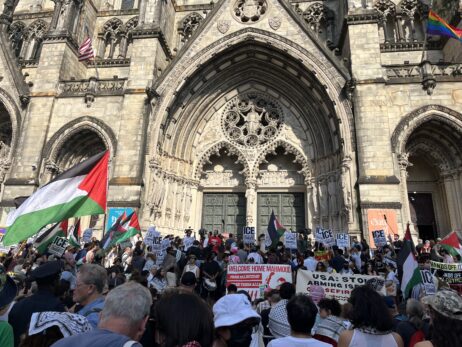
On a brighter note, Columbia graduate and former student protest leader Mahmoud Khalil was released from detention and returned to his wife and infant son in New York City. I was at the rally held on the steps of the Cathedral of Saint John the Divine on Sunday afternoon where Mahmoud spoke passionately about his personal ordeal and the suffering of the other men he met in the ICE detention facility in Louisiana. He said his imprisonment had only firmed his resolve to keep speaking out for Palestine. He then led a march to the gates of Columbia University to denounce the administration’s hypocrisy. His attorneys are still fighting the government’s attempts to have him deported because they claim that his speech is a “national security threat,” but at least now, he is home with his family.

Today is the mayoral primary election in New York City, where Zohran Mamdani is running neck-and-neck with bully and sexual harasser Andrew Cuomo. Because the city now uses ranked choice voting, the results will likely not be known until July 1st. On a side note, I have known Zohran since he was 8 years old and an elementary school classmate of our oldest child. And no matter what the result, I have felt like a proud auntie watching his excellent and practically flawless campaign.

My friend Patricia Ononiwu Kaishian’s inspiring book FOREST EUPHORIA, which was published on May 27, is already a national bestseller, and you can read an excerpt of it on LitHub. Patty and I will be in conversation about the book on Saturday, 28 June at 1 p.m. on Zoom as part of the International Armenian Literary Alliance’s Literary Light Series. You may register to join us here.

The Massachusetts Review published two poems by friend and mentee Sahar Rabah, who is still in Gaza where starvation and daily bombardment continue and are barely covered in U.S. mainstream media. The MassReview also published my young friend T.S.’s powerful piece Why Must We Be Heroes? My mentee Nadera Mushtha’s piece about higher education in Gaza during a genocide was published by The Guardian.

Leila Sansour wrote a clear-eyed if devastating analysis of why Israel is using starvation as a weapon of war against the entrapped and besieged Palestinians in Gaza. In the face of this depraved cruelty, her conclusion is that we must support the rebuilding of Palestinian society: “The strategy to confront it should therefore focus on unwavering commitment to rebuilding kinship, a sense of shared purpose, restoration of community, and civic dignity.”

Let’s follow the example of Ms. Rachel for Littles and do something every day that shows our commitment to creating a world where all children are cherished, where no children are bombed and starved, where families are not torn apart by masked thugs, and where all beings, human and non-human, are respected.

Yours,

Nancy K

P.S. I will be joining The Markaz Review Book Club’s meeting to discuss THE BURNING HEART OF THE WORLD on Zoom on Sunday, July 27 at 1 p.m. ET/19 CET. You can learn more about the book club and sign up for the event here.


Do Something: Advice for Dark Times

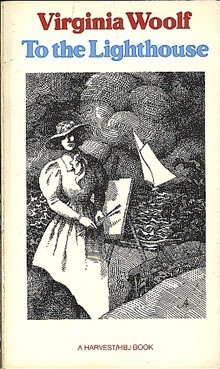
Cover of Virgina Woolf's novel To the Lighthouse. A woman holding a paintbrush and canvas is standing in front of a stormy sea


His immense self-pity, his demand for sympathy poured and spread itself in pools at her feet, and all she did, miserable sinner that she was, was to draw her skirts a little closer round her ankles, lest she should get wet. In complete silence she stood there, grasping her paint brush.

~ Lily Briscoe’s response to Mr. Ramsay in Virginia Woolf’s To The Lighthouse

I’ve been thinking of this scene from To The Lighthouse, a novel that I have read at least a half dozen times, as the horsemen of the apocalypse continue their erratic assaults on all our systems and institutions. Of course, their doings are more depraved and destructive than Mr. Ramsay’s patriarchal self-pity and narcissism, but there is much to learn from Lily Briscoe’s refusal, her drawing her skirts closer to her ankles, and holding onto her paint brush as a tool and a weapon.

What is pooling at our feet is not water, but shit, because as Steve Bannon had recommended, they are spreading the stuff with great abandon. “The Democrats don’t matter,” Bannon told writer Michael Lewis in 2018. “The real opposition is the media. And the way to deal with them is to flood the zone with shit.”

Journalists are kept busy writing about the latest outrage, and the rest of us are barely able to react to one horrible news item before the next one appears. As AOC put it in a February Instagram live: “It’s important for you to understand that the paralysis and shock that you feel right now is the point,” she continued. “They are trying to induce a state of passivity among the general public.”

We must pay attention to what they are doing, but we can’t afford to let them overwhelm us with their crap to the point that we are paralyzed. I glance at the headlines, read various newsletters on topics that concern me, and check out the social media feeds of trusted sources who cover Palestine, the academy, immigration, climate catastrophe, abortion, and policing. During the horsemen’s last reign, a friend recommended a daily roundup curated by Matt Kiser called WTF Just Happened Today, and I find it particularly helpful—Kiser reads the day’s political news and starts with “what happened today in one sentence.” Below that are paragraphs with links going into more depth for those who are interested.

In addition to keeping abreast of the news (without being inundated), I try to push back against their cruelty in the way that I can each day. It’s up to each of us to decide what we care most about and to find the best people working on that issue and then to act. When people ask my spouse James what they should do in the face of the genocide in Gaza or any of the other depredations we are witnessing, he replies, “Do something.”

Yours in struggle,

Nancy K


READ & LISTEN

A long, thoughtful, and essential piece by Taner Akcam about the crisis in Holocaust and Genocide Studies brought about by the genocidal campaign in Gaza.

Publisher’s Weekly finally ran a review of THE BURNING HEART OF THE WORLD, saying, “…the lyrical latest from Nancy Kricorian…is an impactful story of trauma.”

A piece that I wrote about the Armenian genocide, Gaza, and Columbia that was published on April 24 by YES Magazine.

James’s speech at the 25-hour Columbia Speak Out (his is the second one).

I recorded a Podcast interview with Meat for Tea, and did a print interview with LibraryThing in which I discuss my research process, the female bildungsroman, and things Armenian.


Dissonance and Dissidence

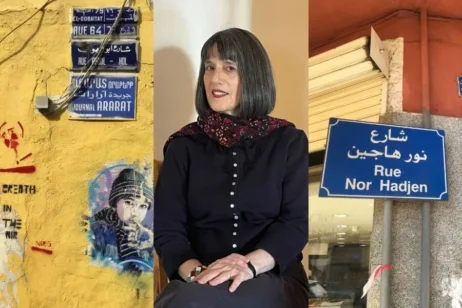
Triptych of wall graffiti, a woman, and a street sign in Arabic, Armenian, and English


Part of the job of being a writer is promoting one’s books, and while I love to praise and promote the work of my friends and mentees, I generally feel uncomfortable trumpeting my own. The current political climate creates an added emotional dissonance—in the face of increasing daily violence and moral shocks, how to hustle to sell a book?

These are scary times. Again, in any direction you look people, their rights, and their well-being are under attack. We are reading about the roundup and imprisonment of dissident foreign graduate students, and witnessing the crushing of our institutions (including a front row seat for the capitulation at Columbia). Palestinian poet Mosab Abu Toha canceled a 16-event national tour because he is subject to a doxxing and smear campaign by far-right organization Betar USA, that has been handing over lists of people it wants deported. The situation in Gaza is truly heinous, with food aid rotting at the border while hunger is rampant and bombings continuous. The announced “voluntary migration plan” for the ethnic cleansing of Gaza is truly sickening.

But we somehow need to keep going, to live our lives, to do our work, take care of our families, and gather with organizations and groups that are fighting the worst of these harms. Palestinian poet and writer Mohammed El Kurd posted some words on Twitter that resonated strongly for me:

the basics: fascism thrives on fear. they want you to be silent, to self-censor, to do less. you will not recover whatever ground you concede. the moment calls for caution, not hysteria. courage, not cowardice. if the objective is fear, be unafraid. dissent.

My writing is also a form of dissidence. As I say in a recently published essay about the making of The Burning Heart of the World in the Armenian Weekly:

April 2025 is the 50th anniversary of the start of the Lebanese Civil War and the 110th anniversary of the Armenian Genocide. My novel reverberates with both of these cataclysms, and it appears at a time when Lebanon and Armenia have just experienced more paroxysms of violence, suffering under existential threats to their sovereignty and territorial integrity. My novel is a journey through these histories and into this burning heart of the world. The title evokes both illumination and conflagration. The world is on fire, and while there is much darkness in the book, there is also humor, empathy and a commitment to amplifying that which is humane in the human. This last is central to my literary project.

The official publication date of my novel is April 1, and I am in Los Angeles for its launch. I have four evening events this week—in conversation at Diesel Books with Talar Chahinian on Monday, a panel discussion with my friends Joanne Nucho, Mashinka Hakopian, and Ara Oshagan on Tuesday at OxyArts, in conversation on Wednesday at the Glendale Central Library with my friend Shahe Mankerian, and a Thursday literary salon featuring poets Lory Bedikian, Arthur Kayzakian, and me hosted by Red Hen Press in Pasadena. The following week in New York, I will be in conversation with Marianne Hirsch at Knox Hall in Morningside Heights on April 7th, and with Raffi Khatchadourian at Greenlight Bookstore in Brooklyn on April 9. On April 15th I will be in conversation with Nanore Barsoumian at NAASR in Belmont, MA, and on April 17th with Lisa Gulesserian at Porter Square Books in Cambridge. For people who are not in these localities, the April 15th event at NAASR will be hybrid with viewing options via Zoom and YouTube. More events are being scheduled for May and June.

May we find the courage to keep speaking out. May we find the strength to protect each other.

Yours in struggle,

Nancy K

RECOMMENDED READING

Variety: Mark Ruffalo, Penélope Cruz and 500 Oscar Voters Sign Hamdan Ballal Letter

Israeli historian Ilan Pappe on the end of Zionism.

My friend Patty Kaishian curated this show at the New York State Museum about the life and work of mycologist Mary Banning.

James Schamus on Andrew Ahn’s updated Wedding Banquet.


New Year, Old Stories


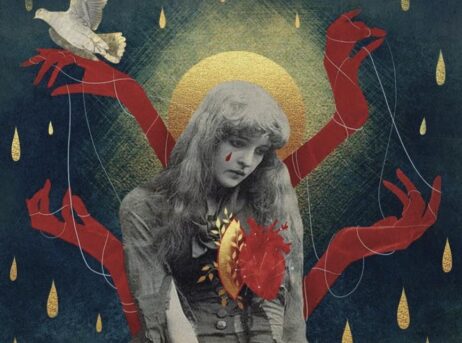
detail of digital collage featuring a crying woman, four red-gloved hands, and a gold and red heart


The first phase of the Gaza ceasefire started on Sunday, and my friends in Gaza experienced the relief of knowing that they had survived fifteen months of a relentless and brutal military campaign against them. One friend went to the shore for the first time in months without fear of being killed by a drone or a quadcopter. Another said they felt joy akin to that of a national holiday, despite the devastating losses that they were still reckoning with. Much is still unknown about what comes next, but there is hope and there will be nights without the constant sounds of missiles, rockets, and drones. I have heard that Trump may force Netanyahu to stick to the phased agreement because Trump, ever in competition with Obama, wants a Nobel Peace Prize and he also wants a deal between Saudi and Israel. Trump has no ideological commitments, unlike Biden who is an avowed Zionist, and perhaps in this case his self-interest will result in something less horrible. May Gaza rise like a phoenix from these ashes and mounds of rubble.


With the ascendancy of Trump and his horsemen of the apocalypse, I’m going to take my news in controlled daily doses. They want us exhausted and demoralized, so we’re going to have to pace ourselves for the hard work ahead.


In other news, when esteemed fiction writer and Nobel laureate Alice Munro died in May 2024, the obituaries were full of praise and the remembrances were glowing. In July, Munro’s daughter Andrea Robin Skinner published a piece entitled, “My Stepdad Abused Me. My Mother Chose to Stay with Him” that reverberated like a bombshell throughout the literary world. Skinner detailed the sexual assault she suffered at the hands of Munro’s second husband and the woefully inadequate way that her parents responded to the abuse when they learned about it, her father months after the incident and her mother years later.


In the 80’s and 90’s, Munro had been one of my favorite writers, and I still have my copies of her books on the shelf. When I read her 1994 Paris Review interview, I had copied out a few lines that I loved into my book of quotations.


I’m doing less personal writing now than I used to for a very simple obvious reason. You use up your childhood, unless you’re able, like William Maxwell, to keep going back and finding wonderful new levels in it. The deep, personal material of the latter half of your life is your children. You can write about your parents when they’re gone, but your children are still going to be here, and you’re going to want them to come and visit you in the nursing home. Maybe it’s advisable to move on to writing those stories that are more observation.


In December, heavily researched pieces about the deeply disturbing story of her daughter’s abuse and Munro’s reactions to it, including ways the writer plumbed the experience in her fiction, were published in The New York Times, The New York Review of Books, and The New Yorker. Writers took to social media to express their dismay and disappointment about someone they had considered to be a literary model, and there were a number of articles about how this new knowledge informs readings of her work.


Last week, New York Magazine dropped an article entitled “There is No Safe Word” about writer Neil Gaiman’s years of sexual predation, which he denied in a statement that I found less than convincing. His former spouse Amanda Palmer didn’t come off too well either. I wish I hadn’t encountered some of the grim details described in the piece, and you might want to read about the article rather than reading the thing itself.


What are we to do about the work we admire by people that we discover have done hideous things? Cultural critic Glen Wheldon has decided to keep past books, but not to engage with future work (which is not an option with Munro, who is no longer alive and writing). I often think about Louis Ferdinand Celine, whose vertiginous and compelling 1932 novel Voyage Au Bout de La Nuit I read and loved when I was a grad student in Paris. How to reconcile the fact that this brilliant author also wrote virulently anti-Semitic pamphlets and embraced fascism? In the New Yorker, Adam Gopnik claims that, “You can’t separate what’s powerful about his writing from his vile anti-Semitism.” He goes on to suggest that the work and the man require a compound response: “an ability to admire, a refusal to censor, and a readiness to condemn.” I find myself, in this rare instance, agreeing with him.


Yours in struggle,


Nancy Kricorian


Recommended reading


Mohammed El-Kurd’s new book PERFECT VICTIMS will be published by Haymarket Books on February 11, and you can pre-order a copy here.


An excellent piece by Jane Partizpanyan via the Armenian Weekly about Genocide in Gaza, a media cover-up, and our moral obligation as Armenians.

Also from the Armenian Weekly, Armenian Women Bake Bread and Hope: “…during the blockade, we understood what bread truly means — standing in line all night for just one loaf and returning home empty-handed without knowing how to feed our children.”

Samia Saliba has made a list of 31 recommended SWANA books being published in the first half of 2025, and my novel THE BURNING HEART OF THE WORLD (which can be preordered here) is included.


Recommended viewing


Wonderful lecture on the origins of Armenian-American music by Ara Dinkjian via Houshamadyan.