2026 April

Doing and Undoing


Little by little the cotton is spun. ~ Armenian proverb

Every year on the 24th of April, Armenians around the world commemorate the start of the Armenian Genocide in 1915. For me this date is firmly anchored in my memories of my Armenian grandmother and the congregation of the United Armenian Brethren Church that my grandfather helped to found. My survivor grandmother and the other survivors of her generation in our church, many of them having been orphaned as children, were carriers of a traumatic history that was rarely articulated, but which suffused our community. Their experiences of unspeakable mass violence, dispossession, and exile were passed to the next generations as both a burden and a legacy.

I have always felt that my commitment to fairness as a child and to justice and accountability as an adult are the fruits of having grown up in the Armenian community. In this violent and frightening time, each day I try to find one kind thing I can do or one cruel thing I can help undo. Sometimes I do this alone, but most times I am part of a group. And these small acts and the relationships we make as we do them are the best antidotes to despair.


Recommended viewing, reading, listening

In honor of Armenian Genocide Remembrance Day here is a short video about the history of the Armenian village of Anjar in Lebanon’s Bekaa Valley. It features my friend Antranik Dakessian.

As reported by LitHub, a collective of autonomous writers, artists, and musicians has launched the 92NO campaign to call on their colleagues to withhold their labor from the Arts and Culture Program of 92NY because of the institution’s support for war and genocide. You can follow 92NO on Instagram and X/Twitter.

My WANN mentee Taqwa Ahmed Alwawi wrote a searing piece for LitHub about scholasticide in Gaza.

This is must-read interview with Dr. Ghassan Abu Sittah about health sovereignty in Palestine.

This fascinating episode of the Psychic Militancy podcast features a discussion with Avgi Saktepoulou and Iris Hefets about the Palestine Global Mental Health Network’s call for all psychoanalysts of conscience to resign from the International Psychoanalytic Association.

Palantir posted a 22-point “Western” tech supremacist manifesto on X/Twitter the other day that was described as sounding like “the ramblings of a supervillain.”  Eliot Higgins of Belling the Cat had a good BlueSky thread in response, and Yanis Varoufakis offered a point by point translation. If you’re interested in taking action against this company that poses a threat to humanity, sign up for the Purge Palantir campaign. More information is available from the American Friends Service Committee.

I was impressed by Wikipedia’s guide to spotting AI generated writing, and if you want a short primer, you can watch this reel by Will Francis.


Nancy Kricorian


The First of April


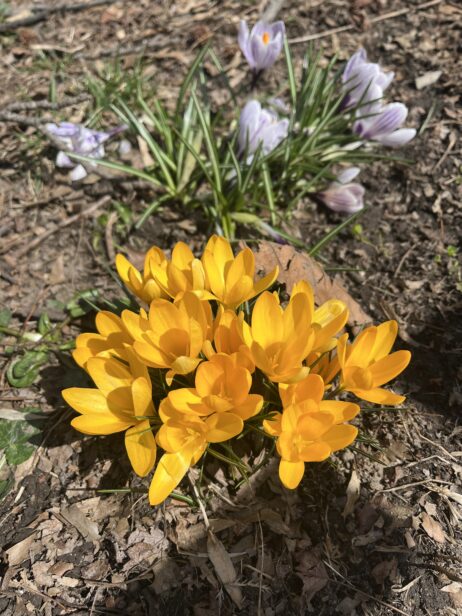
When the first crocuses appeared this year, I thought to myself, “We made it!” as though winter were a battle that we had survived. Now it’s April. The daffodils are blooming in Morningside Park, and the ornamental cherries are flaring their pink skirts along Central Park’s reservoir. I have never been a fan of practical jokes, hoaxes, or pranks, so April Fool’s Day is not a custom that I observe. April 1st was, however, my Armenian grandmother’s chosen birthday. As an orphaned genocide survivor whose birthdate was inscribed in a lost family Bible, she knew neither the day nor the year of her birth. April brings spring showers, spring flowers, and in Armenian the word abril (ապրիլ) is both this month and the verb to live.

How do we live in this dystopian moment when mere minutes of reading the headlines is like sprinting through a raging fire? While walking down the avenue, I am struck by how normal and peaceful everything appears even as I am carrying with me the knowledge of the mass murder of schoolgirls in Iran, the targeting of journalists, medics, and other civilians in Lebanon, and the ongoing genocide against the people of Palestine. And then there are the domestic horrors. So, after I register all of this, I must find something doable and I must do it. I know you have heard this from me before, but I literally repeat these phrases in my head each day, sometimes more than once: The only recognizable feature of hope is action (Grace Paley); Choose your lane, find your people (Mariame Kaba); Freedom is a constant struggle (Angela Davis).

My WANN mentee Nadera wrote a beautiful, sad piece about celebrating Ramadan before and after the genocide. I’ve been going to weekly meetings of our neighborhood deportation defense rapid response (DDRR) group. I have also been working with the DSA-NYC Immigrant Justice Working Group and its efforts with the Purge Palantir coalition. I did some preliminary campaign research on Palantir—truly the stuff of nightmares. (If you want to see my draft research document, let me know and I’ll send it to you, but in the meantime, check out Palantir CEO Alex Karp’s latest shenanigans.) There was some good news this week as the New York City Health and Hospitals Corporation announced they would not be renewing their contact with Palantir when it comes to an end in October. On another front, I’m collaborating with an autonomous group of fierce and clever writers on a campaign to hold a major cultural institution to account. We are finding moments of satisfaction, and, dare I say, joy in our work together.

Gathering in the real world with friends and family is another way of fostering light in dark times. James and I recently hosted a launch party for our friend Tim Mitchell’s brilliant new book The Alibi of Capital. In February, we restarted our old tradition of a monthly Sunday brunch. At our second gathering in March, as I looked around the table at our friends, I remembered lines from The Elder Edda (as translated from the Icelandic by Paul B. Taylor and W.H. Auden):

If you know a friend you can truly trust,

And wish for his good will,

Exchange thoughts, exchange gifts,

Go often to his house.

Finding these moments of connection make the work possible.

Yours in struggle,

Nancy

READ, LISTEN, LOOK

On March 13, The Burning Heart of the World was knocked out in the first round the Tournament of Books, but the judge’s reasoning and the conversation below were interesting. On March 27, I lost in the Zombie round, but there was some laudatory commentary.

In the good news department, a federal court has found that Columbia University may have acted as a government instrument to suppress Palestinian advocacy in violation of the First Amendment. This finding means the suit will go to discovery and all those emails between the craven trustees and their sketchy congressional partners will become public.

Via Mondoweiss Psychoanalysts are Resigning from the International Psychoanalytical Association over Its Anti-Palestinian Double Standard. Dr. Avgi Saketopoulou, a New York analyst and theorist, named something rarely spoken publicly: that the IPA’s silence has ‘created a permissive professional atmosphere in which Zionist analysts feel entitled to eruptions — saying racist and discriminatory things to their patients and supervisees — both in the consulting room and on our email lists.’

Arundhati Roy on the war against Iran: Any regimes that need changing, including the US, Israel, and ours, need to be changed by the people, not by some bloated, lying, cheating, greedy, resource-grabbing, bomb-dropping imperial power and its allies who are trying to bully the whole world into submission.

We Live in a Time of Monsters—a message from Beirut by Lina Mounzer: But we have learned from Gaza that there is no rule of law, and there are no repercussions for the crimes of the powerful.

Listen to the brilliant Aslı Ü. Bâli via Jewish Currents’ On the Nose Podcast.

Via Instagram. Enjoy these Heated Rivalry themed posters from 28 March No Kings Day. And take the Heated Rivalry Quiz (should I be proud or embarrassed to say that I knew all the answers?).


Nancy Kricorian