now

The Lean Years

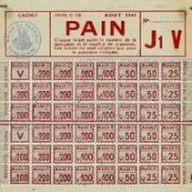
ration ticket
A ration card for bread

During World War II, food was rationed in France. People were issued ration tickets for bread, vegetables, meat, milk, and wine. (There were also ration tickets for non-food items such as tobacco and fabric.) Often, however, even if you had the tickets, the food items were not available on the market shelves. The German war machine was using France as its breadbasket. One of the nicknames local Parisians called the occupiers was doryphores (potato bugs) because most of France’s potatoes were shipped off to Germany. But it wasn’t only the potatoes that the Nazis requisitioned: they also took the best of French wheat, bread, butter, cream, cheese and vegetables.

If you cash to buy things at exorbitant prices on the Black Market, if you were a farmer or had friends or family who were farmers, you would be able to get your hands on decent food. Poor and working class city dwellers, and even the middle class, were left to subsist on what the Germans didn’t take. Root vegetables such as rutabagas and turnips, which had before the war been fodder for cattle, were staples. There were ersatz foods, such as jam made from what remained after grapes were pressed for wine, and instead of coffee or tea, people made do with chicory.

In the novel, the Pegorians supplement their meager war rations through ingenuity and resourcefulness. Teenaged Missak uses his slingshot to bag a duck or two in the park. Maral is dispatched by bicycle to cousins outside the city who have a backyard vegetable garden and later a chicken and egg business. The Pegorians plant tomatoes in window boxes, they barter, and eventually they risk using forged ration tickets. But during the war, they are often hungry. After another meal of bulgur and rutabagas, Maral complains that they all are suffering from “rutabaga-itis.”


Nancy Kricorian


Living History

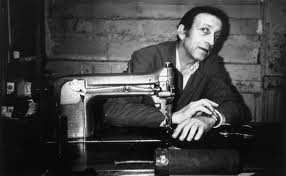
Arsène Tchakarian, Member of the FTP-MOI Resistance Network (born 1916)

In order to create the characters in my novels, I collect stories. It’s like being a collage artist, or maybe more like a bird building a nest with twigs, grasses, old feathers, bits of twine, and other scraps. I find these stories in history books, memoirs, letters and documentary films. For all three of my novels so far, I have had the good fortune of talking with people who lived through the events that I am dramatizing in my fiction.

When I was in Paris doing research for ALL THE LIGHT THERE WAS, an Armenian friend named Hagop was my “fixer,” for which I am forever indebted. He located for me an Armenian woman who was seven years old when the German troops had marched down the Rue de Belleville. She told me how her family had briefly hidden one of her schoolmates whose family had been taken during the infamous Vel d’Hiv roundup of Jews in July 1942. Hagop and I went to visit an Armenian nonagenarian who had been an amateur actor in the Parisian Armenian community theater and a member of the Hunchak (Communist) resistance. He repeated several times the story of an Allied bomb that had gone astray in his Paris neighborhood, upending a rabbit hutch and killing his wife. He repeated, almost in wonder, “My wife was dead, but all the rabbits were still alive.” Hagop also arranged a meeting with Arsène Tchakarian, one of the last surviving members of the Manouchian Groupe, the Communist resistance network of immigrant workers immortalized in “L’Affiche Rouge.” Tchakarian has devoted his life to documenting the work and the lives of his friend Missak Manouchian and other members of the Resistance who were executed by the Nazis at Mont Valérien.

These stories and many others were in my head as I sat down to write in the voice of Maral Pegorian, the protagonist and narrator of ALL THE LIGHT THERE WAS.


Nancy Kricorian


The Red Poster

affiche rouge

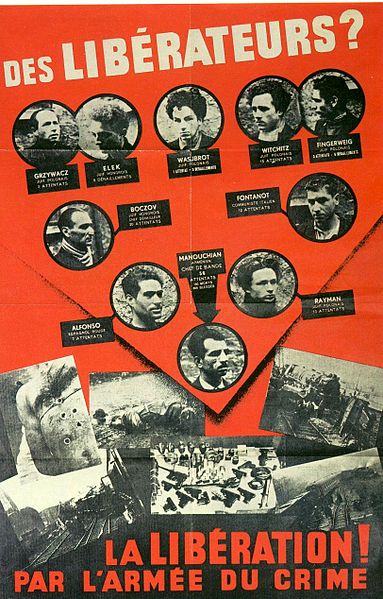
Soon after the execution of Missak Manouchian and the other members of his resistance network in February 1944, the authorities plastered the walls of Paris with a red poster. Featuring medallion photos of the group’s members, the poster read: “Liberators? Liberation by the army of crime.” The verso of the famous Affiche Rouge proclaimed, “If French people pillage, steal, sabotage and kill, it’s always foreigners who give the orders; it’s always the unemployed and professional criminals who carry out the acts; and it’s always the Jews who inspire them. Strangle them now before they strangle you, your wives and your children.”

The foreign names and ugly mug shots (taken after the men were interrogated and beaten) were supposed to disgust the French public. But people dropped flowers at the foot of the walls where the posters hung, and under cover of night people scrawled across the poster the French patriotic slogan, “Mort pour la France” (Died for France). Missak Manouchian, Maurice Fingercwaig, Marcel Rayman, Spartaco Fontano, Arpen Davitian, Olga Bancic and the rest became martyred heroes of the French Resistance. They were later commemorated in a 1955 poem “Strophes Pour Se Souvenir” (Lines for remembrance) written by Louis Aragon for the inauguration of a street in the 20th arrondissement. To this day, the street is still called “Rue du Groupe Manouchian.”


Nancy Kricorian


Terrorists in Retirement

terrorist in retirement

While doing research on the uses of political violence by “non-state actors” for my second novel Dreams of Bread and Fire, I came across a 1984 French documentary entitled Terrorists in Retirement (original title Des terroristes à la retraite). It told the story of a French Communist Resistance network made up of immigrant workers. The network’s leader was an Armenian poet named Missak Manouchian. In late 1943, the Germans arrested Manouchian and twenty-two members of his group, which was comprised of Eastern European Jews, Armenians, and Italian and Spanish refugees. The men were executed by firing squad at Mont Valérien in February 1944. The sole woman was executed by beheading in Germany some months later.

After reading a little more about Missak Manouchian, an Armenian Genocide survivor who immigrated to France in 1925 when he was nineteen years old, I realized even as I was writing my second novel that I had found the time period and milieu for my next book. How did the Armenian community of Paris live the four years of the Nazi occupation? What had it felt like for Genocide survivors who had rebuilt their lives in France to look out the window on German troops marching down the Rue de Belleville? My third novel, All the Light There Was, grew out of these questions.


Nancy Kricorian