You wake up in the morning and forget where you are. The smell of coffee from the kitchen. The sound of slippers across the linoleum floor. It could be any country.
When you look in the mirror you see the eyes of your grandfather. He expects something from you, but he won’t tell you what.
Better to go into captivity with the whole village than to go to a wedding alone.
The fabric was torn. With scraps you have made a tent, you have fashioned a kite, you have sewn a dress, you have wrapped yourself in a flag.
They have separated you with gun, grenade, barbed wire, wall, prison, passport. They have underestimated your will.
The hungry dream of bread, the thirsty of water.
Passing from one village to the next, without obstacle, without document, without your heart thumping up near your throat.
Turning the key in the lock, you enter through a door you have never passed through before except in your grandmother’s stories and in your dreams.
This week, controversy erupted when six writers who were scheduled to be “table hosts” at PEN’s Gala Fundraiser on May 5th pulled out of the event because they didn’t believe that French newspaper Charlie Hebdo should be awarded the PEN/Toni and James C. Goodale Freedom of Expression Courage Award. This was first reported in the New York Times, and then Glenn Greenwald posted about it at The Intercept, also including the texts of letters exchanged between some PEN members and PEN Executive Director Suzanne Nossel.
This morning I was among the first thirty PEN members to sign an open letter on the issue. The circulation of the open letter was reported by Vulture this afternoon, and now there are discussions raging in the comments sections of various articles, on Twitter and Facebook, with people lining up on one side or other of the debate. As this is going on, more writers are adding their names to the open letter.
My spouse James Schamus offered a clarifying comment.
I mourn the terrible murders of the Charlie Hebdo staff.
I stand in solidarity with those who fight against the scourge of intolerance, censorship and bigotry.
I know that the defense of free speech and a free press means defending principles that allow, in practice, for speech that offends and that is often, at its worst, even hateful.
But defending the rights of all to free expression should not require of me the obligation to award, condone, or applaud any particular expression, even expression made by those who have been cruelly and violently silenced.
I will stand beside Charlie Hebdo and all others in the fight to guarantee freedom of expression for all. I will not, however, stand and applaud for Charlie Hebdo, at a gala awards dinner or anywhere else.
I am not Charlie Hebdo.
UPDATE:
2 May 2015
The list of signatories has grown to close to 200 by this morning, and the vitriol against the writers who signed is intense. I am dismayed that some people don’t seem to understand the distinction between supporting Charlie Hebdo’s RIGHT to publish what they will and declining to support the granting of this award. Clearly the dam has broken among New Yorkers who no longer want their commitment to free speech to become conflated with crude bigotry.
The Kardashians at the Armenian Genocide Memorial, 10 April 2015
On April 24, 1915 over 200 Armenian intellectuals, clergy, lawmakers, and other leaders in Constantinople were arrested and sent by train to Ankara. Most of them were subsequently killed. This attack on the Armenian leadership was the opening chapter of a concerted genocidal campaign by the Ottoman government against its Armenian subjects. The deportations, slaughter, monumental land and property theft, and forced assimilation of widows and orphans decimated Armenian communities throughout Anatolia, Cilicia and other regions of what is now Turkey. Dispossessed and traumatized Armenians who survived these horrors were dispersed around the globe.
Armenians observe April 24th as Armenian Genocide Remembrance Day. April 2015 marks the centennial of the genocide, and there are commemorative events scheduled in New York, Los Angeles, Washington, D.C., Paris, Istanbul, Diyarbakir, Yerevan, and around the world. The Turkish government, which has for decades mobilized denialist propaganda in textbooks, press accounts, academic conferences, and world forums to undercut Armenian claims, went so far this year as to move Gallipoli commemorative events—usually held on March 18 to mark the Battle of Çanakkale and also remembered on April 25th as Anzac Day—to April 24, 2015 in a bid to deflect attention on the occasion of the Armenian Genocide Centennial.
TV celebrity and social media sensation Kim Kardashian’s recent visit to Armenia generated an enormous volume of publicity about the Armenian Genocide in many unusual outlets, such as this piece on E Online: “Kardashians Take Armenia! 10 Fascinating Facts to Know about the Country’s Culture and History.” A carefully staged and art directed visit to the Tsitsernakaberd Genocide Memorial in Yerevan was widely reported, including on Buzzfeed. Kim’s sister Khloe Kardashian posted to her Instagram feed:
“My sister and I are trying to bring awareness not only to our Armenian genocide but genocides and human slaughter in general. Knowledge is power! If we know better than hopefully we shall do better. Genocides, massacres, human slaughter… are despicable acts attempting to wipe out an entire race is not what God intended. Educating people as to what happened in history is our duty. It is also our duty to not be silent whenever and wherever human beings endure suffering and humiliation no matter their race or creed. Silence encourages the tormentor, never the tormented.”
I’m on the board of Project 2015, an effort to organize a mass fly-in of Armenians for centennial commemorative events in Istanbul. Our team has been working with partners in Turkey for six months to plan a series of events, including a concert, an Armenian Heritage tour of Istanbul, a public outdoor vigil, an academic conference, and a public art ritual. I’ve been closely involved in the conceptualization of this final event, and drafted the press advisory that went out at the end of last week announcing the Wishing Tree Public Art Ritual to Honor Victims and Survivors of the Armenian Genocide.
On the eve of these commemorations, Pope Francis gave a public address in which he referred to the Armenian Genocide, thereby angering the Turkish government. While these centennial commemorations are an opportunity to focus the world’s attention on the Armenian Genocide, once the clamor has subsided we will continue our long struggle in a variety of forms and forums for justice and redress.
In the spring of 2013, around the launch of my third novel ALL THE LIGHT THERE WAS, I started sending out a newsletter of sorts, usually twice or three times a month, to friends, family and interested readers. Below is the latest missive. If you’d like to be on the mailing list, drop me a line at nkbookgroup@gmail.com.
Dear Friends,
I’m sending you a quick update because I wanted to share with you this week’s highlights! I had a great trip to Los Angeles—it was an utter delight to escape from NYC’s interminable winter and have a taste of spring in California. My two talks went well, and I got to hang out with old friends and new.
Herewith, as I promised last time, is Project 2015’s two-minute promo video in which I explain why I’m going to Istanbul for the Armenian Genocide Centennial Commemoration. Please watch and share. (And maybe you want to join us in Istanbul?)
On Friday, Armenian students in Toronto organized a brilliant action at a lecture by two speakers who specialize in genocide denial. My friend Corey Robin posted the article to Facebook with this commentary:
This, by a group of Armenian activists at the University of Toronto, really is the best kind of protest against loathsome speech (in this case, against two denialists of the Armenian Genocide, one of whom is a prominent American conservative). The student activists didn’t try to stop or ban the speeches. They just allowed the speakers to say a tiny bit, then turned their backs on them, prompting furious but futile attempts to get the activists kicked out, and then walked out en masse, leaving the speakers with a pitiful audience of 20 supporters. This is the way to shut down (without shouting down) denialists, racists, and the like: f*ck with their heads, disrupt through silence, and demoralize the sh*t out of them.
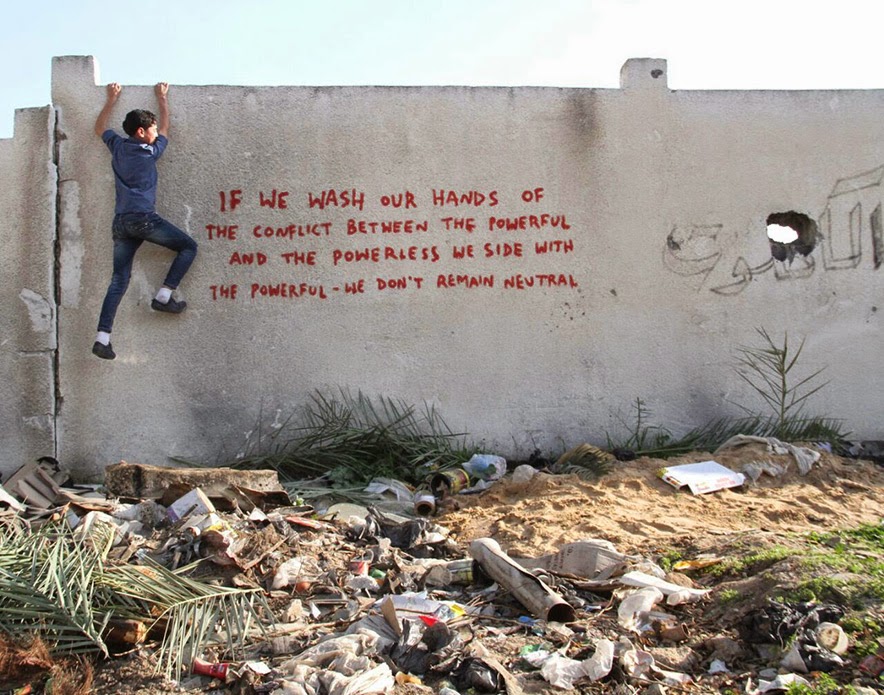
And last, but not least, earlier this week the street artist Banksy revealed new works and a brief “travel” video that he shot in Gaza. As the artist wrote on a wall in Gaza, “If we wash our hands of the conflict between the powerful and the powerless we side with the powerful—we don’t remain neutral.”
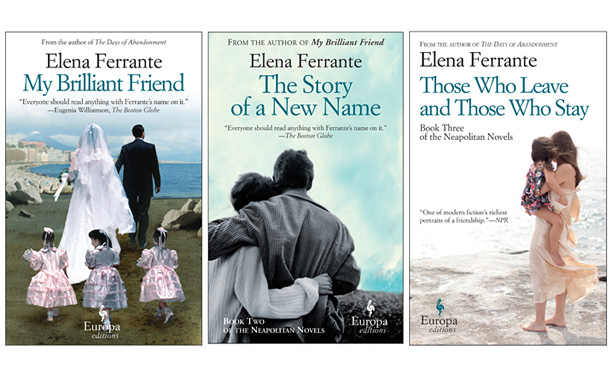
True confession: in ten days, I have read five novels by Elena Ferrante. I picked up a copy of MY BRILLIANT FRIEND, Book One of Ferrante’s Neapolitan novels, at a local bookstore, and tore through the pages in a frenzy. We are introduced to a pair of girls from Naples, Elena and Lila, whose friendship spans from the late forties until the first decade of the 21st century. Elena is our first-person narrator and not always reliable guide, who upon learning that her friend has disappeared at the age of 66, goes back to the first days of their complex, fierce and competitive friendship as young girls. We are plunged into a post-war, working class neighborhood in Naples where life is lived with great intensity and passion. It is also a violent world—men beat their wives, parents beat their children, and children kick their dogs. Elena and Lila are what we would now call “gifted” children. They are determined to use their intelligence and drive to lift themselves out of poverty and to escape from the drudgery and hardship they see in their mothers’ lives.
Her prose, translated from the Italian by Ann Goldstein, is not showy at the level of “craft.” What make the books compelling, even riveting, are the unflinching descriptions of negative emotions and impulses that women experience and usually leave unsaid: terror, fury, jealousy, self-hatred, and more. Ferrante is above all a great storyteller, and there is a narrative drive that makes her work propulsive and addictive.
I’m not going to give a plot summary, but suffice it to say that on the last page MY BRILLIANT FRIEND, Elena describes a shocking scene at the wedding of her best friend Lila. It is a cliffhanger. (As an aside, the term ‘cliffhanger” originates from Thomas Hardy’s 1873 serialized novel A PAIR OF BLUE EYES. A character is hanging from a cliff at the end of one of the chapters, and readers at the time wouldn’t know what happened to the young man until the subsequent chapter ran in the next month’s paper.)
I scurried out to buy Books Two and Three of Ferrante’s series, which I galloped through in quick succession. The fourth and final book was published in Italian towards the end of 2014, and the English translation will appear stateside in September 2015. How could I possibly wait until then? I was suffering from Ferrante Fever. (Yes—there is even a Twitter hashtag #FerranteFever.) I dashed out to the bookstore and bought two of Ferrante’s earlier, shorter novels, THE DAYS OF ABANDONMENT and THE LOST DAUGHTER, which I inhaled within 48 hours. These earlier works are much shorter and less complex in terms of plot and characters than the Neapolitan novels—they feel almost like studies on the themes that are taken up on the broader canvas of MY BRILLIANT FRIEND. I just ordered a copy of TROUBLING LOVE, the one available Ferrante translation I haven’t read, and I’m counting the days until the publication of Book Four of the Neapolitan novels, THE STORY OF THE LOST CHILD.