now

Ghost Children

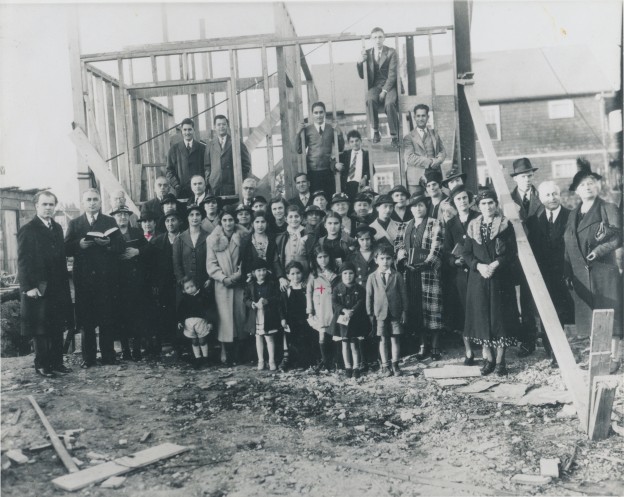
The new church building on Arlington Street
The congregation of the Armenian Brethren Church circa 1938.


Our family attended the Armenian Brethren (Evangelical) Church on Arlington Street, in Watertown, Massachusetts. My grandfather, Levon (Leo) Kricorian, was one of the founders of the church. Its congregation was made up of survivors—and the children and grandchildren of survivors—of what was called at the time “the Massacres,” “the Deportations” or “the Catastrophe.” Later this tragic chapter in Armenian history became known as The Genocide (1915-1921).

The Genocide was only occasionally openly addressed in our community, but vague allusions and scraps of stories floated around me without my ever gathering them into a coherent narrative. One of these fragments was a line that my grandmother said in passing about one of her close friends, Mrs. Mary Amiralian. In reference to Mrs. Amiralian’s grown progeny, one of whom was my Sunday school teacher when I was in grade school, my grandmother said, “Those are her American children. The first ones died in the desert.”

Years later, after my grandmother and Mrs. Amiralian had died, when I was researching my novel Zabelle and reading voluminously about the Armenian Genocide, this bit of conversation came back to haunt me. In response I wrote the poem “Ghost Children.”


Ghost Children


At lunchtime I stand
at the stove spooning soup
into three white bowls.
My children eat bread
at the table. They laugh
at the milk moustaches that
I wipe from their faces.

On the pantry floor I see
the narrow shadows of the
other children, the ones
whose bones I left in the
desert in a garden of bones.
The sand is still in my hair;
their high voices in my ears.

My American children can’t
see their unlucky brother and
sister who follow close by
my skirt. Mairig, the ghosts
complain, we are hungry. Mairig,
give us something to eat.


Published in ARARAT Literary Quarterly (Spring 1995)
Recording of the author reading “Ghost Children” via The Armenian Poetry Project

* Mairig means Mommy in Armenian


Nancy Kricorian


Hemming Dresses


Nancy and Grandma on Easter Sunday. (Dress hemming done by Grandma.)


When I was growing up, my Armenian grandmother hemmed my dresses. And for many years, I would wear only dresses. (Being forced by my mother to wear snow pants when I was in the first grade caused me paroxysms of grief.) I stood on the footstool in my grandmother’s bedroom while she pulled straight pins from a red pincushion and slid them through the fabric folded to the chosen length. Appropriate length was a subject of much discussion between us.

“How long?” she asked.

I pointed to a spot mid-way up my thigh, which was at the time the fashionable length but a little shorter than was comfortable for me. I had learned from experience that no matter what length I indicated, and no matter what length we agreed upon, the finished product would be at least two inches longer. So I asked for too short, knowing she would make her own adjustments for the sake of modesty.

“What?” she asked. “You want the whole world to see your vardik?”

“No one will be able to see my underwear. It’s not that short.”

She shook her head. “These are the last days. Everyone is walking around showing their vodik and everything else.”

This last bit of dialogue about panties, Biblical end times and public display of private parts was repeated each time I stood on the footstool for a dress fitting. Sometimes my grandmother digressed into a discussion of bikinis, which she considered to be a true sign that Christ’s Second Coming was at hand.

I finally outgrew my hatred of slacks when I was about twelve years old, and my grandmother and I moved on to a new frontier in hemming. By some logic that I never quite understood, my grandmother believed that while skirts should be long, pants should be short. It took several pairs of slacks that bared my ankles before I recognized the system and asked for them to be at least two inches longer than I actually wanted.


Nancy Kricorian


Cookie Tin Full of Buttons

Vintage Buttons


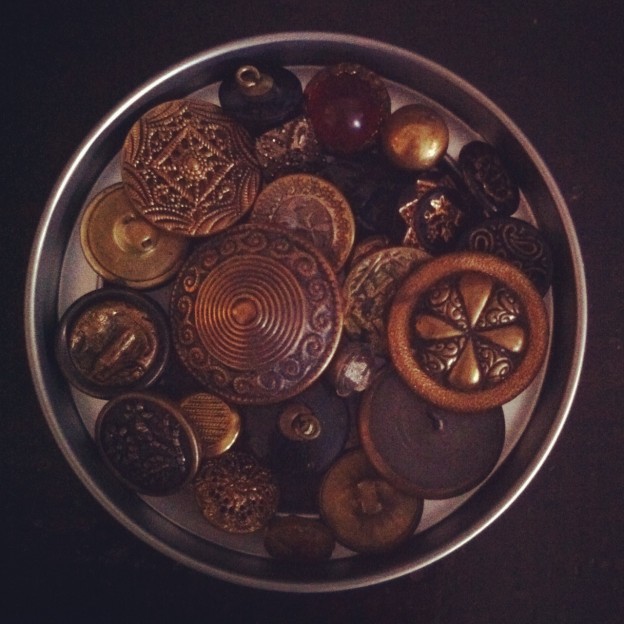
When my grandmother first arrived in the United States as an immigrant bride, she worked sewing buttons on shirts for a local manufacturer. In the bottom drawer of her bureau there was a dented cookie tin filled with buttons. Some of them dated from her time at the shirt factory, and the rest she had saved slowly over the years. When a shirt was torn beyond repair or frayed beyond wearing, she snipped off the buttons and added them to the tin. I spent hours playing with the buttons, sorting them by color and arranging them into patterns and shapes.

In my third novel, ALL THE LIGHT THERE WAS, Maral Pegorian’s mother is a vest maker who does piecework at home. Like my grandmother, Azniv Pegorian has an old cookie tin filled with buttons. When Maral wants to entertain a little girl she’s babysitting one afternoon, she pulls out the tin. She says, “There were buttons with two holes and those with four, plus metal and leather shank buttons. The colors were varied: shiny gold, red ones, all shades of white and brown, and thin disks made from shimmering mother-of-pearl.” This is a description of my grandmother’s buttons.

My favorite in my grandmother’s collection was a dark brown shank button that had come from an old cloth coat. The button was made of plastic, decorated with silver filigree, and had a green rhinestone in its center. After my grandmother died, I used a safety pin to attach this button to the lapel of a vintage black gabardine jacket that I wore all the time.


Nancy Kricorian


Armenians and Sacred Trees

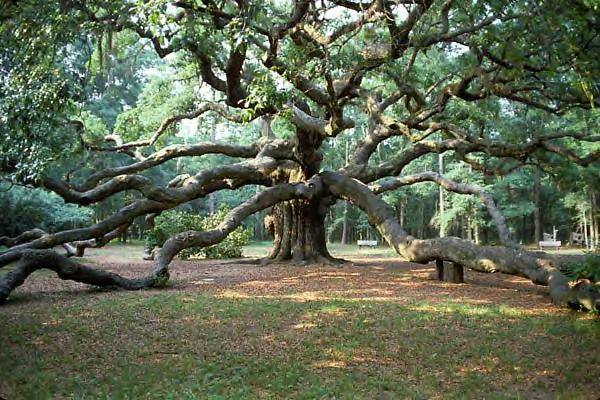
Ancient plane tree
Ancient Plane Tree

For he had been dedicated to the cult of the plane trees at Aramaneak in Aramvir. The murmuring of their foliage and the direction of their movement at the gentler or stronger blowing of the wind were used for divination in the land of the Armenians, and that for a long time.

Moses Khorenatsi, History of the Armenians  (5th century A.D.)

According to historian Moses of Khoren, Anushavan Sosanver, grandson of the legendary Armenian king Ara the Beautiful, was dedicated to the cult of the plane trees at the sacred grove in Aramvir.

Sos is the Armenian word for plane tree, and the word for rustling is sosapiun. Anushavan’s name—Sosanver—means “dedicated to the plane tree” and also evokes the rustling of the tree’s leaves. Plane trees were planted in churchyards until the 10th-13th centuries. Christian religious authorities discredited the plane trees because of their relationship to pagan practices, but people still designated specific trees near holy sites as sacred.

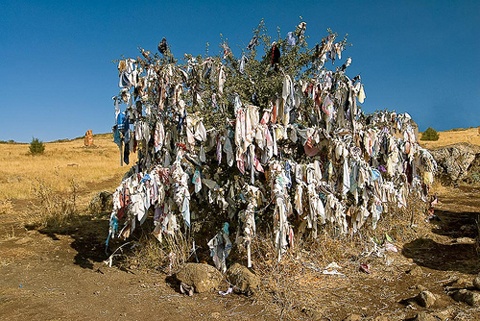
To this day, near many ancient churchyards and small roadside chapels, you can see a tree that is festooned with rags. Armenians go to tie a piece of cloth on these “wishing trees”; each rag represents a wish or a prayer that the supplicant hopes will be granted by God.

Wishing Tree
A ‘wishing tree’ in the southern part of Armenia, in the Syunik region


Nancy Kricorian


Shoemakers of Belleville

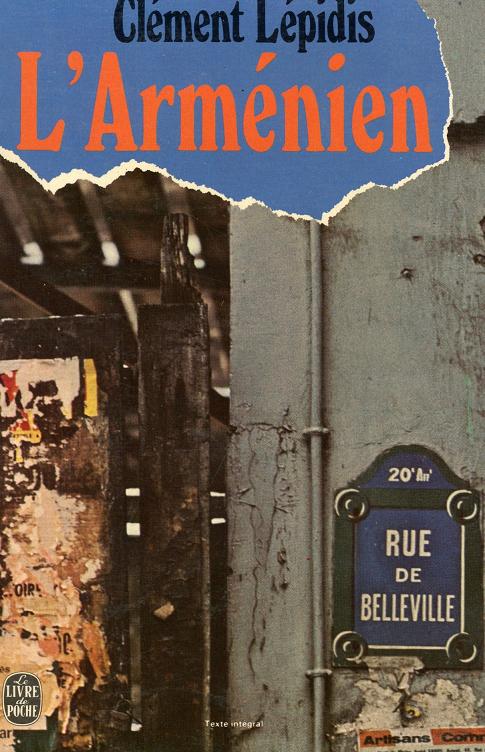
Novel by Clément Lépidis


During my first research trip to Paris, I went to the Librairie Orientale Samuelian not far from the Luxembourg Gardens. Alice Aslanian, whose father had founded the bookstore in 1930, remembered me from a previous visit and pointed out a copy of Zabelle they had among their wares. She pulled from the shelves a number of books that she thought would be germane to my research, and then went to the back to find a yellowed paperback copy of a book that was out of print and difficult to find: L’Armenien by Clément Lépidis, originally published in 1973. (It has since been reissued by Desmos.) This she generously offered to me as a gift.

Lépidis, who was born in 1920 and died in 1997, was a French writer of Greek descent. His immigrant father had fled Anatolia during the anti-Christian massacres and ended up working in the shoe trade of Belleville. (In Paris between the two wars Greeks and Armenians dominated fine shoemaking.)

The protagonist of L’Armenien was Aram Tokatlérian, an Armenian Genocide survivor trained in an orphan school as a shoemaker, who had come to France to start a new life. He found work in a Belleville shoe atelier in the thirties. In this novel, Belleville was alive with vibrant characters, the scents of spices in the Armenian food shop, the smell of the tannery where the shoemakers procured the leather they used, the sounds of the cobbler’s hammer and accordion music from dance halls.

Lépidis wrote two memoirs–Des Dimanches à Belleville (Sundays in Belleville) and Je me souviens du 20e arrondissement (I Remember the 20th Arrondissement)—that evoked in loving detail the neighborhood of his childhood, which was more like a village than an urban enclave. Reading these books was a way to immerse myself in the atmosphere of Belleville during the 30’s and 40’s, and was immensely helpful in my imaginative creation of Maral Pegorian’s world.


Nancy Kricorian