now

Urgent Appeal from Women in Armenia


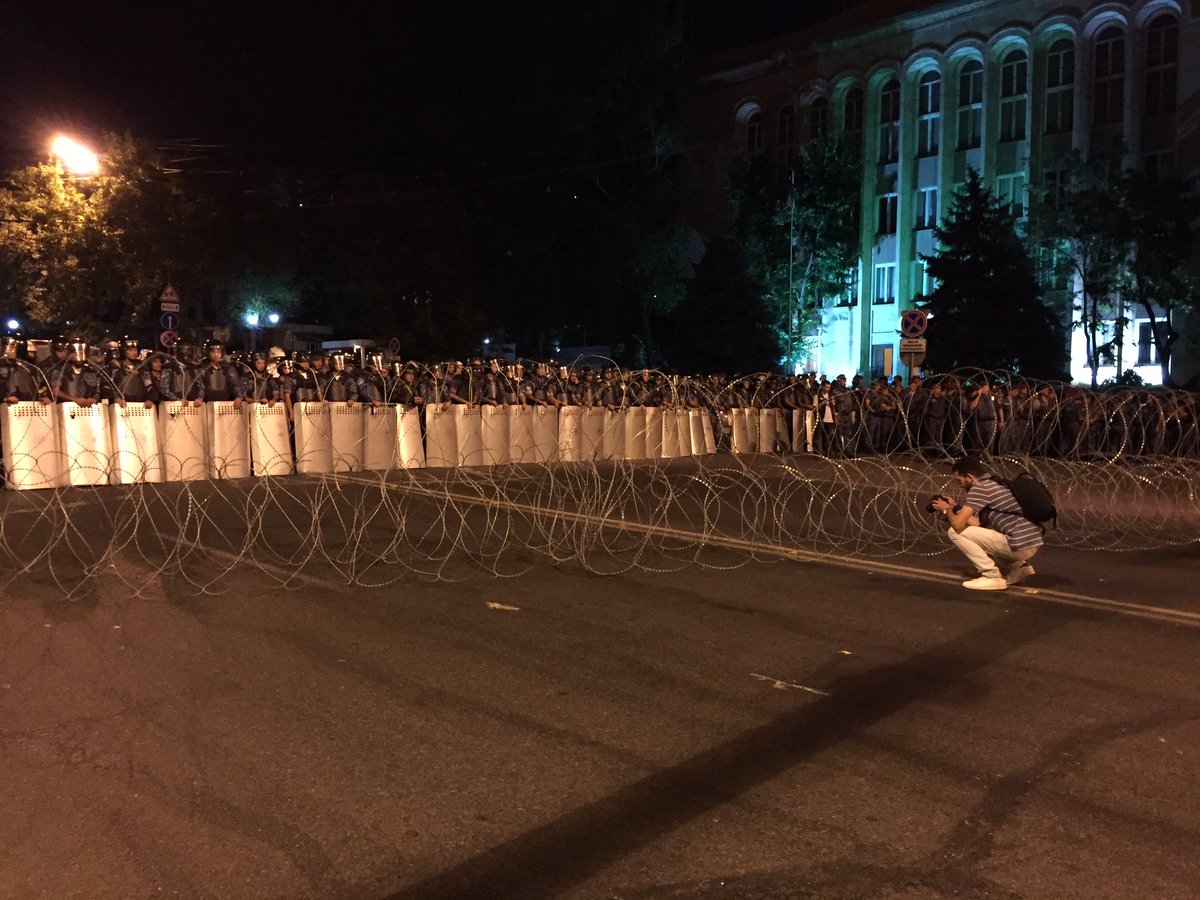
Police and Barbed Wire Blockade in Yerevan, 7/16
Police and Barbed Wire Blockade in Yerevan (Photo by  Babken Der Grigorian, 7/30/16)


I received the below appeal from a friend in Armenia. The stand-off between the police and the “Daredevils of Sassoun” who have occupied the Erebuni police station has drawn crowds of civil society activists into the streets. For background on the situation read this article from Open Democracy. For an account of Friday night’s events, read this from The Guardian.


The anger and despair in Armenia about the oligarchs (also known as gangster capitalists) who are running the country are at flood levels. While many disagree with the methods of the men currently blockaded in the police station, there is a widespread disgust with state violence used against civil society activists and the unchecked corruption and venality of the current government. The women signatories of the below message are calling for action and support from Armenians in the Diaspora, as well as from global citizens.


****

Dear Friends,

Please take into consideration and disseminate this call from the women signatories based in Armenia to the Diaspora.


PLEASE DISSEMINATE THIS MESSAGE NOW!


Yesterday, on July 29 2016, an act of State terror was organized in Erebuni (Yerevan) where people have been protesting for the last twelve days. The local media documented numerous incidents of torture and ill treatment by the Police of RA and its special units, including kidnappings, unlawful detentions, enforced disappearances, setting people’s houses on fire, intimidation and violence against children and elderly. The police also stormed into random people’s homes, terrorizing and beating them and their family members, severely brutalized injured people who were seeking help in hospitals, and beat hundreds of people held in police stations.


To adequately address these acts of police brutality and mass violation of human rights and fundamental freedoms, we, civil society members in Armenia, NEED the following SUPPORT from the ARMENIAN DIASPORA:


  • We need PUBLIC FIGURES to COME TO ARMENIA to raise awareness and to stop the violence unleashed by the regime against the peaceful citizens of Armenia (we are specifically calling on Loris Tjeknavorian, Rakel Dink, Serj Tankian, Cher, Margaret Ajemian Ahnert, Garry Kasparov, Atom Egoyan, Patrick Devedjian, David Barsamian, and other influential Armenians and non-Armenians);


  • Sensitize the Armenian diasporan media and demand that the media TELL THE TRUTH, covering what is actually happening in Armenia NOW to effectively stops state violence;


  • SENSITIZE THE INTERNATIONAL MEDIA to start covering the state terror in Armenia;


  • Organize RALLIES in front of ARMENIAN EMBASSIES, block the events with the participation of Armenian officials, do other actions to delegitimize everything done by Armenian officials;


  • Organize RALLIES in front of INTERNATIONAL ORGANIZATIONS, notably the UN;


  • Put pressure on all Diasporan entities, including individuals to cut funding for the Armenian government or government-backed projects;


  • Put pressure on international institutions that fund the government through loans and grants;


Any other support by which the Diaspora can help to deprive the current regime of authority and reputation, funding resources and the psychological and authoritative support of institutions, states, etc.


WE NEED YOUR PRESENCE!


Gayane Abrahamyan

Anahit Simonyan

Lara Aharonian

Gayane Hambardzumyan

Anna Shahnazaryan

Lusine Talalyan

Arpi Adamyan

Shushan Avagyan

Zaruhi Hovhannisyan

Maro Matosyan

Nvard Manasyan

Arpine Galfayan


********

UPDATE: On the night of 31 July 2016, the “Daredevils of Sassoun” surrendered to police, ending the 15-day standoff. All 20 were arrested. One of them said, “We have done our part, now it’s the people’s turn to ensure fundamental change in Armenia.”

On August 1st, 2016 Human Right Watch issued a report on the Armenian police’s use of excessive force at the July 29th protest.


Nancy Kricorian

New York City


Midsummer Update

medeaRNC


In the past few weeks, the world has witnessed a series of murderous attacks, ranging from the U.S. “mistakenly” killing more than 70 civilians in Syria, and suicide assaults in France and Afghanistan, as well as a failed coup in Turkey, which has now resulted in a purge against suspected plotters as well as a witch hunt against journalists and academics. The presidential election pageant, which seems to be stretching into infinity, would be hilarious if it weren’t so terrifying. My mood was buoyed by watching from afar as my CODEPINK friends and colleagues disrupted the proceedings at both conventions.


This Friday my spouse James Schamus’s directorial debut will be opening in New York City and Los Angeles, rolling out in other markets in the following weeks. There was a fine profile of James in this past Sunday’s New York Times Arts section. Billboard Magazine ran a piece about the 1950’s pop song James and composer Jay Wadley wrote for the film. So far most of the reviews have been great, with many more to post in the next days and weeks. I particularly liked this one from Deadline: “As for Schamus, whose previous screenplays have largely been collaborations with Ang Lee, he turns in an extremely accomplished directorial debut proving there is great life beyond the executive suites in Hollywood.” And I must share the Rolling Stone review by Peter Travers: “Schamus reveals his gifts as a filmmaker who respect the words and the space between them in equal measure.”


In literary news, my review of Atef Abu Saif’s The Drone Eats with Me: A Gaza Diary was published in the July issue of IN THESE TIMES Magazine. I thought this article about “The Subtle Art of Translating Foreign Fiction” was worth sharing—and it has a few paragraphs for those still recovering from #FerranteFever. Also, there is a new (non-fiction) Ferrante book being published by Europa Editions in the fall—Frantumaglia: A Writer’s Journey. Another fascinating glimpse into the writing life is this thoughtful piece by Viet Thanh Nguyen, entitled “Winning the Pulitzer changed the value of my book and myself.”


And finally I wanted to share this beautiful essay and accompanying photograph by Antoine Agoudjian in which he pays tribute to Armenian resilience in the face of terrible loss.


Nancy Kricorian


The Birds of Beirut

49e2dc20-2edd-425f-a51a-ebe94856d6f5

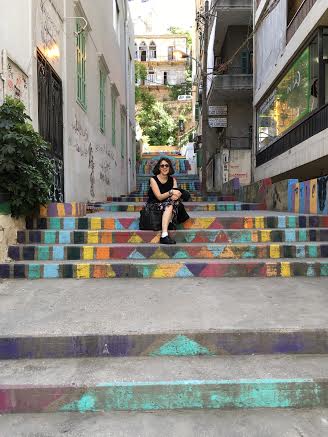
Mar Mikhael steps, Beirut

I arrived in Beirut on Friday night, and on Saturday my hosts drove me to the Armenian village of Anjar in the Bekaa Valley, close to the Syrian border. The women of the ABC Book Club had set up a large television set and thirty chairs on a spacious home patio. Members of the book club made short speeches about the history of their group, an introduction to my work, and a brief reading from my second novel, DREAMS OF BREAD AND FIRE, which they had read and discussed. Then I presented my “Armenian Diaspora Quartet” slideshow, weaving in two poems, “The Angel” and “Homage to Bourj Hammoud.” After the presentation, we ate homemade Armenian and Lebanese desserts in the garden. My favorite was a fruitcake called kumba, a specialty of Anjar (made from a recipe the Armenians of Musa Ler had brought with them in the late 30’s). My hosts insisted that I take home the entire platter of kumba. When I asked, “What will I do with all this?” I was told, “It has no eggs or butter; it keeps forever. Eat what you like, and at the end of the week you can put it in your suitcase.” (Believe me, I did it.)

The next evening was April 24th, and I went with friends to the Armenian Genocide vigil in Martyrs’ Square in downtown Beirut. After listening to the speeches for a while, we walked around the soulless ghost town that is the Solidere reconstruction of the old Souk area. The following day when I ventured out on my own—trying to get to the Sursock Museum to see the Assadour show—I got horribly lost. When I had showed the receptionist at the hotel a map, and asked for directions from the hotel to the museum, she looked at the map as though she had little idea of what it was, let alone how to read it. People in Beirut don’t use maps, and the available ones are pretty terrible, so for a person such as myself with absolutely no sense of direction, navigating the city was a challenge. A soldier at an intersection noticed my confusion, asked me where I was going, told me that I was very far from my destination (I had walked for fifteen minutes in the opposite direction), and explained that the only way for me to get there was by taxi.

The rest of the week, volunteer guides—old friends, new friends, and an aspiring fiction writer who is a student at Haigazian University—accompanied me. They were all locals who negotiated the maze of streets without maps. After the first afternoon of walking around in Bourj Hammoud, I despaired of ever being able to properly situate my characters in the space. But by the final day of my trip, I had determined the street where the Serinossians resided, the church they attended, the school where the children were enrolled, the father’s occupation, and his place of work. For later reference, I took photos of old wooden houses, mid-century apartment buildings with balconies and awnings, Armenian schools, Armenian churches, streets signs, and old doors. I also identified a few common birds: laughing dove, house sparrow, rock dove, and white wagtail. In Bourj Hammoud and Nor Hadjin I saw canaries in wire cages and zebra finches in wooden ones.

Equally importantly, I heard stories of the war years—the kinds of anecdotes that provide me with the small details I need to create the narrative world of the novel. Here is one line I heard that opened up a universe of feeling: “Sundays were sad days—because the ships took them to Cyprus, and from there they flew away.”


Nancy Kricorian

New York City


Raise Your Pen For Freedom

My contribution to the #RaiseYourPenForFreedom social media campaign


Last year at this time I was in Istanbul for Armenian Genocide Centennial commemorative events. It was a sad milestone, but it was also a time that was full of hope. Our Project 2015 organizing team and almost two hundred participants had flown in from New York, Los Angeles, Paris, Yerevan, Beirut, and other cities. My experiences in Istanbul that week were so inspiring that I was fully planning to return the following year, thinking that I would even go to Diarbakir, the de facto capital of Turkey’s Kurdish region, for the 101st anniversary of the genocide on April 24, 2016.

Last April my friends in Istanbul—Turks, Armenians, Kurds, and ex-pat Americans—were excited about the prospects for the upcoming elections in June 2015. They were supporting HDP (the People’s Democratic Party, a left-wing and anti-nationalist coalition), many of them electioneering for the party and all of them hoping that it would cross the 10% threshold for entering the Turkish parliament. There was jubilation when they succeeded.

Fast-forward to a year later and the situation in Turkey is worse than I could have imagined possible. Erdogan’s failure to win the super majority he needed to change the constitution and to consolidate his presidential power led him to reignite the war against the Kurds. Kurdish towns and cities were placed under military sieges with round-the-clock curfews lasting for weeks and months. The district of Sur in Diyarbakir, where the recently restored Sourp Giragos Armenian Church is located and where I visited in June 2014, is now a blasted-out war zone under threat of an “urban renewal” project that is a combination of a construction boondoggle for Erdogan’s cronies and a “cleansing” program aimed at the PPK (The Kurdistan Workers Party), but also at poor and working class Kurds. The church itself has been slated for expropriation by the government.

Turkish nationalists inside and outside the government whipped up anti-Kurdish sentiment, accusing anyone who criticized the war on Kurdish cities and towns of supporting terrorism. Once again rumors spread purporting that members of the PKK were actually Armenians, those perennial traitors to the Turkish state.

Added to all this, there have been a number of bombing attacks, two claimed by ISIS in Istanbul tourist districts, one in Suruc, and one in Ankara attributed to an offshoot of the PKK. The Turkish government continues to play a double game with regard to the Syrian war, seeing the Kurdish YPG militants in Northern Syria who are fighting ISIS under U.S. protection as a bigger threat than ISIS itself. (Admittedly all the political actors involved in the Syrian Civil War are playing double and even triple games.)

In January academics in Turkey signed and circulated a peace petition entitled “We Will Not Be Party to This Crime,” denouncing the renewed state violence in the Kurdish southeast. Within days, a witch-hunt had started against the professors and graduate students who had signed the letter, with twenty-seven of them temporarily detained, and dozens suspended and fired from their jobs. International professional associations and many academic institutions sent letters and petitions to the Turkish government decrying this crackdown on academic freedom and free speech. But in March three professors were arrested and charged with “Propagandizing for a Terrorist Organization.” This week the arrested academics will go on trial in Istanbul, and a call for a social media solidarity campaign has gone out under the hashtag #RaiseYourPenForFreedom.

I decided I wouldn’t be going back to Istanbul or Diyarbakir this April; instead I’m heading to Beirut on a research trip for my current fiction project. Turkey’s democracy has been on a downward trajectory this year—sad for me from afar, but devastating for the Kurdish communities that have been subjected to brutal military siege, and frightening for the academics and journalists who are threatened and harassed for their dissent. As HDP’s co-chair Selahattan Demirtas put it in his New York Times op-ed last week, “By ending the peace process with the P.K.K., by creating a repressive security state, by shelving the rule of law and by cracking down on free speech, he is drowning what is left of Turkey’s democracy — making this country more susceptible to radicalism and internal conflict than ever.”


Nancy Kricorian

New York City


Homage to Bourj Hammoud

Homage to Bourj Hammoud

Have you heard a thrush sing while its nest burns in the wind?

~ Khalil Gibran

Listen. In the morning you can hear the bright strike of hammers and the rasp of saws. Children carry sand from the riverbanks in their school satchels. First they build the church, then the school, and finally a house for each family according to its means. The tents and shacks are taken down one by one. Each family plants a mulberry tree and tends its garden. 

The remnants of Marash create a new Marash. And so also Nor Sis, Nor Adana, Nor Giligia, and Nor Hadjin are made. You can hear the sounds of the trades learned in the orphanage workshops: carpenter’s plane, sewing machine and cobbler’s bench. The sharp smell of the tannery is in the air and in their clothes. All Beirut wears their shoes.

Look at the children outside the church in their freshly pressed clothes, and the girls have ribbons in their hair. Look at the food spread on the luncheon table and the hands that pass the platters. Someone has told a joke and there is laughter. Someone pulls an instrument from its case. 

Speak of those times, or don’t, when the parties take up arms against each other. How the women of one church throw boiling water out the window on the men with guns. When all Beirut stops fighting, for how many more weeks do the Armenian men continue to shed each other’s blood? 

Speak then of the flowering: the neighborhood children grow tall. Among them are musicians, actors, painters and poets. In this world their parents have rebuilt from ashes, they now believe anything is possible, and everything is new.  

Remember this: when the Civil War comes, neutrality is no amulet against the bullets and the bombs. Jewelers flee the downtown souk for Bourj Hammoud, where the militiamen patrol the night and then also the day. So many boats leave the port. Carrying leather suitcases to the airports, so many are exiled again. 

Remember Nor Adana, Nor Marash, Nor Sis. Men still play backgammon and grill meat on braziers on the sidewalk. Remember the narrow alleys and wooden houses of Sanjak Camp, razed for a shopping plaza. Oh people of long memory, listen, look, speak, remember: your stories are a homeland. 

Nancy Kricorian

This piece appeared in the 2015 PEN World Voices Online Anthology